Exhibits / Orcas Island’s First Residents-
Northern Straits Salish People
The original inhabitants of Orcas Island are referred to as the Northern Straits Salish People. These tribal nations occupied the island for thousands of years, fluctuating between seasonal and year-round residency. These early people lived in long houses made of wide cedar planks connected to posts and beams, as well as in tents during the summer. They relied on dugout canoes for water travel. The women were master weavers, transforming tule and cattail fibers into mats, as well as dog wool and duck down into blankets. According to the research conducted by linguist Dr. Wayne Suttles, the first occupants of Orcas and the other San Juan Islands spoke the Northern Straits language. Descendants of these early people are present day members of the Lummi, Samish, Songhees, and Saanich Nations.
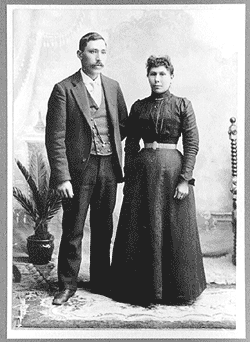
Both were from families of Northern Straits Salish
and European-American descent.
Marriages of Cultures
From the exhibit...
There was a sense of interdependence between the Coast Salish people and the area’s new non-Native immigrants beginning in the 1840s. Newcomers depended upon the First People’s knowledge for survival and access to resources. In turn, the original groups came to rely upon the new settlers for trade and sometimes protection. Alliances between the old and the new cultures, like the alliances between different Tribal Nations, often took the form of marriage.
Many of the men had come out west to seek their fortune, and ended up working in the mines in British Columbia or being employed by the Hudson’s Bay Company. They were typically in their late twenties or thirties when they married. The women tended to be younger, usually in their mid-teens. By this age, Coast Salish women were regarded as ready for marriage as they had received a formal education in the ways of food preservation, shellfish harvesting, medicinal plant use, cooking, and childcare, in addition to many other survival skills. This was important cultural knowledge passed on to them by their older female relatives.
The marriages were arranged by the young woman’s parents and her prospective husband, with both parties agreeing on the exchange of goods and services they would provide each other. Within the Coast Salish culture, this exchange was the formal marriage contract. Parents considered men who were prominent in local politics and business to be desirable and eligible new family members. The women were active participants in the marriages, assisting as financial supporters of their new families as well as helping develop their homes and surrounding property.
Mixed marriages in the islands and surrounding areas were acknowledged for the most part as being socially acceptable, considering that most of the white men living here the first 25 years after settlement had Native American wives. However property ownership became an issue of concern in the Washington Territory (Washington didn’t become a state until 1889) when evaluating mixed marriages. Government officials were worried about the “consequences” of a Native American wife, or the couple’s mixed children, inheriting their husband/father’s assets and land claim. Also with the arrival of Christian missionaries, these marriages were discredited as simply being liaisons.
As a result, a series of marriage laws were passed between 1854 and the 1870s that required a “legal” (paper) marriage overseen by a Justice of the Peace or a minister. While some couples complied, others disregarded the laws as being disrespectful to their existing marriages.
Later generations often struggled with their mixed heritage, and chose to identify with either their mother’s traditions or their fathers. Those who chose to return to their Native American traditions often moved onto the reservations. Societal pressures and wide-spread racism even forced many children and grandchildren to remain silent about their family’s formation.
As with cultures everywhere, sometimes these unions were long-lasting and loving, and in other situations they were failures. Visit the museum to learn about some of these remarkable women, their husbands and their resulting families.