Exhibits /
Early Island Industries-
Lime, Wood and Farming
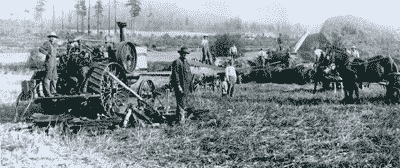
Early woodworking and farming equipment, along with images of island industries such as the West Sound sawmill, the Kimple brick yard and island lime kilns are displayed in the Nels Olsson cabin.
Lime Quarries and Kilns
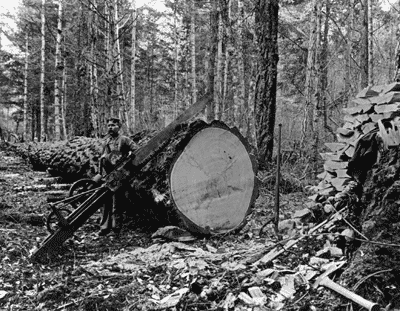
San Juan County’s old growth forests were harvested to fuel an estimated 35 lime kilns, stone and brick furnace-like structures used to reduce limestone to a white powder called lime, the multi-purpose substance and the primary ingredient for making concrete.
The islands’ commercial lime industry flourished between the 1860s and the 1930s, with locally produced lime being shipped to cities situated along the west coast of the United States, and as far away as Mexico, South America and the Hawaiian Islands. Most notably, lime derived from San Juan County limestone was used to reconstruct San Francisco after an earthquake devastated the city in 1906.
Historians believe that most of the 35 kilns ran 24 hours a day, seven days a week, eleven months a year. Each kiln required at least four cords of wood a day to attain and remain at the required 1600 degrees F. In only fifty years, these kilns burned an estimated 2,352,000 cords of wood!
Few kilns still exist today, although visitors can view a beautifully restored example at Lime Kiln State Park located on San Juan Island.
Millwork
In 1905, brothers Allan, Frank and John Chase opened a sawmill in West Sound. The mill produced quality grade lumber, which was shipped in scows hauled by the company’s towing boat, the HERMOSA. Bill Williams eventually purchased the mill, and was the owner when the mill burned to the ground in 1924.
The Fruitful Years
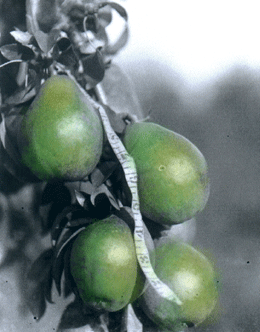
Homesteaders settling on Orcas during the 1870s faced the huge task of clearing old-growth forests in order to grow crops for cash income. Fruit orchards were planted where the trees once stood, thriving in the mild climate and rich soil. Italian prune-plums were the first fruit trees planted on Orcas (c. 1875), chosen because they produced fruit within three years.
After 10 to 12 years however, these trees were bearing small-sized fruit that didn’t generate enough money on the market. As a result, growers turned their attentions to raising strawberries, apples, pears, cherries, peaches and apricots. At the height of the fruit farming industry, shipments leaving the Eastsound dock for Seattle and Bellingham contained about 30,000 boxes each of apples and pears, per season. Olga, Orcas and West Sound docks were points of departure for thousands of boxes of fruit as well.
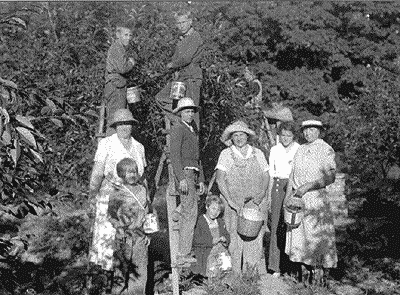
Eventually fruit production in Eastern Washington and California began competing with orchards in San Juan County. An increasing number of insect pests, such as the tent caterpillar, also contributed to the downfall of the local fruit industry. A few island farms continued into the 1940s, but eventually even the packing boxes cost more than the fruit they contained.